
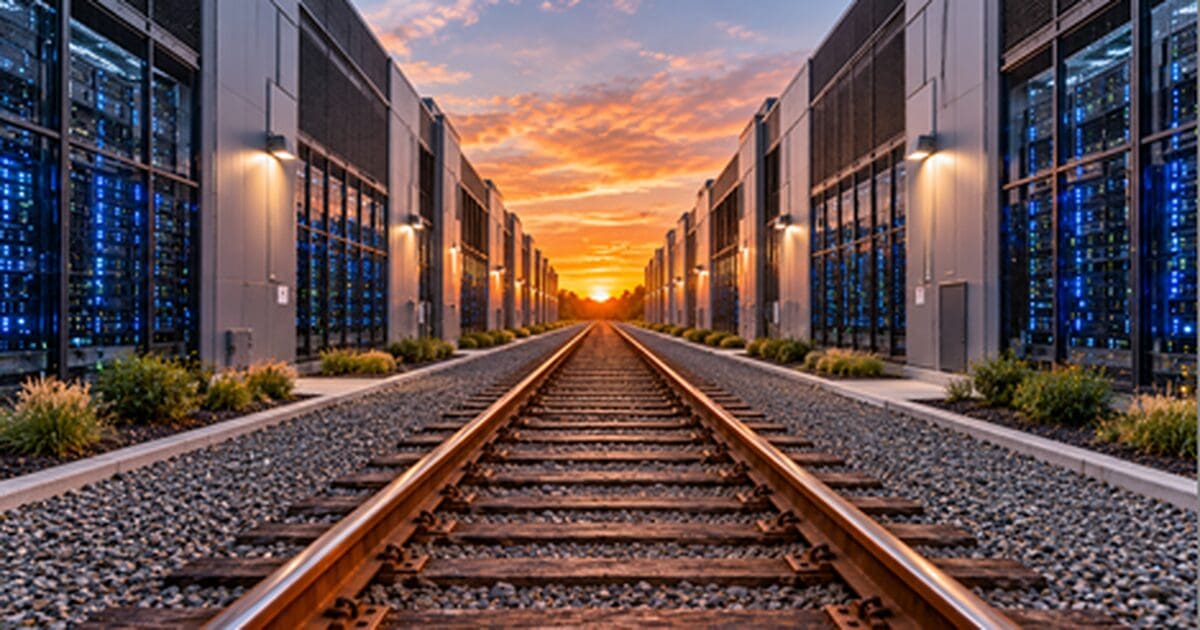
3rd Quarter 2026 Commentary & Outlook
The times they are a-changin’, and we believe they are unfolding as we anticipated over the last year. Despite the fear, uncertainty, and doubt that always exists about the future, our glass is at least half full, and we believe our portfolios should benefit from most of what is likely.
In the mid 1960’s Bob Dylan wrote his song in a different era for different problems. What is good today may be bad tomorrow, and the challenges of today may be the silver lining for tomorrow. Everything changes except human behavior. Expect revelations and expect change. They are coming.
“The line it is drawn, the curse it is cast
The slow one now, will later be fast
As the present now, will later be past
The order is rapidly fadin’,
And the first one now, will later be last,
For the times they are a-changin’”
Bob Dylan, 1964
REASONS FOR OPTIMISM
- Artificial Intelligence (AI) impact is accelerating. We have been cautious not to bet on who will be “the winner,” and instead own what all participants need – land, water, and power.
- Data center demand has never been higher. Having water, inexpensive & clean energy, and a pro-growth jurisdiction has never been more important. That’s what we own.
- Interest rates have risen. We own very few bonds, and the few that we do own are very short in maturity.
- Inflation continues to go up. Many of our holdings are “asset light” and may benefit from increasing inflation.
- Energy prices are high. We own beneficiaries of increasing global demand.
- Private credit problems are exposing the risks in their wholly owned insurance companies. We do not own either the private credit funds, nor the general partner.
PAUSE OR PEAK?
Let’s start by saying, thus far, it has been a good year. Through the first nine months, the S&P 500 index is up 12.75%, and the average large U.S. company is up 10.03%.1 However, the developments of the last few weeks have caused concern. Rising inflation, interest rates, and energy prices may have stalled the artificial intelligence (AI) ebullience.2 Whether this is the ‘pause that refreshes’ or a regime change, only time will tell. What is not slowing is the demand for AI data centers nor the resources on which they depend.
QUARTER IN REVIEW
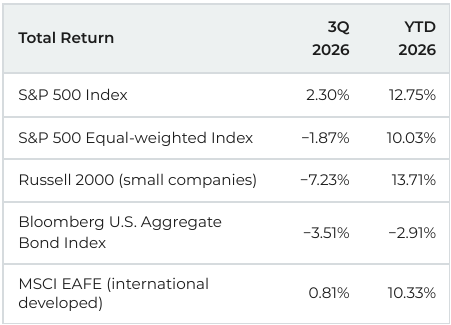
This quarter, the S&P 500 index was up, even though the prices of so many of its constituents were down. The concentration in the S&P 500 continues, with the top ten companies comprising nearly 40% of the index.3 With the reliance on the AI train to keep rolling down the tracks, we see increasing risk. Anthropic’s valuation has dropped from $2 trillion only a few months ago to less than $1 trillion today.4 To get the public to “bite,” they are proposing to give away 5% of the company.5
These are not philanthropists. Their recent acts of “generosity” are strictly to get the IPO done. It reminds me of the sign in the rug merchant’s window, seven years old, “Going out of business, all inventory must be sold!” Such a deal.
To be clear, the businesses of the hyperscalers should do fine. Apple, Google, Microsoft, Amazon, etc. have dominant franchises, high cash flow and near monopoly market positions. If there is an economic shock, their stock prices will go down, but survival is not in question. It is the outer layer of companies reliant on debt, cancelable purchase contracts, and high IPO valuation proceeds that are at risk.
ECONOMY
The U.S. Gross Domestic Product (GDP) grew at 2.2% in large measure due to the buildout of data centers. The average American is financially stressed, and yet the upper income consumers spend unabated. How much longer this can continue is hard to know.
This past week, the Consumer Price Index rose 3.7% year-over-year, and Producer Price Index rose 6.3%.6,7 Interest rates have been rising most of the year, and the 10-year Treasury hit a 24-year high on September 30th.8 The inflation numbers make it difficult for the Federal Reserve to avoid interest rate increases. However, we do not anticipate much more than a half point rise. In our opinion, given the choice between higher rates causing a recession or allowing inflation to run “hot,” inflation will be seen as the lesser of two evils.
GROWING DEFICIT
The snowball that has been rolling downhill for years, the annual deficit and total debt, has not been in the news lately. The annual deficit for this past year will come in around $2 trillion, up 12% from last year’s deficit. Government spending fuels growth and feels good until it is time to pay it back – just ask the people in France. This is a problem no one wants to talk about. Recurring deficits have historically caused inflation.
Investors are wise to own assets that should be the least affected, or even better, ones that are inflation beneficiaries. In general, that means asset light companies and those who can pass through costs to customers.
MIDTERMS
One thing which won’t change much is the upcoming midterm elections. Many political forecasts anticipate a blue wave and if it arrives most things will remain as they are. The newly elected will try to flex their power and the old guard will resist. Stories of conspiracy abound and who doesn’t like a John Grisham novel?
As to practical matters, international relations are likely to remain strained. The Ukraine standoff and the Middle East war will largely be unaffected. Congressional gridlock will continue, the annual deficit will continue to rise, and the other party will be to blame. The administration’s new friendship with the Russian dictator may disappear as quickly as it arose.
One area that is on our radar is the moratorium on data centers. Moratoriums are not legally binding and in many red states will probably go quiet into the night. The one state of interest to us at the moment is Texas. It is possible data center development could be slowed but in our opinion is unlikely. There is too much business waiting and every indication is Texas wants it.
AI FEEDING FRENZY
With the current explosion of AI, Brookings Institution estimates up to $10 trillion will be spent on building out data center infrastructure capacity in the next eight years.9 The spending on AI can be compared to government spending in the 1940s during the Second World War. The world’s largest companies and countries are viewing AI supremacy as an existential threat that must be won at “any cost.” Some estimates are that Americans will have to spend as much as 9% of GDP on AI-related services for the participants (combatants) to earn a reasonable return on the $10 trillion dollar buildout.
Data centers are the villains of today. Some say they would prefer a nuclear power plant in their backyard. A Gallup survey released in May 2026 found that 70% of Americans opposed having a data center built near them.
To put the magnitude of the economics in context, estimates are that it will cost as much as $1.3 billion annually to power each gigawatt of energy that these warehouses require.10 That does not include the $40 billion for the building, racks, servers and coolers. If you own the land, provide the water and earn a royalty on the power consumed, you have a very good business.
Meanwhile, the price of AI usage (the cost of processing text, measured in “tokens”) has plummeted, dropping 47% per quarter over the last three years, faster than for any other transformative technology in history.11 The biggest beneficiaries, in addition to the consumer, may be those who take the least capital risk.
As heavy users of AI, we see the application everywhere. Yet we land firmly in the camp that many of the early innovators may not survive. A few will thrive, some will be acquired, and the rest will fail. Not knowing which few companies will thrive has led us to conclude the “safer” place to be is owning the companies that sell the supplies to the combatants or receive a toll on traffic patterns that we think are likely to increase.
SMOKE OR FIRE?
There is a narrative that a cadre of AI companies are facing financial stress. It is showing up in the insurance companies owned by private equity firms, their private credit funds, and delayed IPOs. If the problems are company specific, they may be absorbed by larger players. If the problems are related due to over-optimistic revenue projections to pay back debt, the financial distress could be more widespread.
One of the “edge” AI companies, a neo-cloud provider, CoreWeave suffered a blow this past week. Both their stock and bond prices collapsed as concerns about their viability mounted. As a new data center company attempting to arbitrage the cost of building data centers and their debt, CoreWeave is inconsequential in the big picture. That is, unless their distress is indicative of the inability of the AI labs (OpenAI and Anthropic, et al.) to meet their financial obligations.
It reminds me of late April in Connecticut when I watched a few of the neighborhood kids skating on the frozen pond. Occasionally, there would be a deafening boom when the ice moved. You couldn’t know how thin the ice was. We built snow forts instead. The ice is thinning in many parts of the leveraged AI financing game. For generational wealth to compound, it must first be preserved.
PORTFOLIO THEMES
Securities exchanges
In general, the business remains robust with year over-year double-digit volume growth in most cases, though some of the stock prices are flat or down. What matters more is the operations of the companies: revenues, profits, market share and free cash flow. When those metrics are favorable, stock prices catch up. When the stock prices lag, we add to positions.
We conducted our own study on the 17-year history of the publicly traded security exchanges. The time frame was determined by the earliest dates for credible comparison. Our results confirmed what we had read elsewhere. Over time, owning the common stock of the exchanges has proven significantly more profitable than an index measuring the stock on the exchange or the S&P 500 index. We see nothing that should change this in the visible future.
Land, Water, Power
Increasing energy prices have played a big role in the stock prices going up, though that is not why we own these companies. We believe the companies we own may be major beneficiaries of the inevitable, decades long, data center buildout. They benefit from location, jurisdiction, and increasing demand.
This past summer, I went to Midland, Texas to hear a presentation from Texas Pacific management at the Permian Basin Museum. Later, six buses took the group on a site visit to a TPL water reclamation site. The company is attempting to develop an inland equivalent to a saline water treatment plant but designed to filter out toxins related to that specific geography. If successful, the technology could be very profitable. Either way, I was reminded that almost 80% of the surface land TPL owns has had no drilling to date. The upside optionality of this company is impressive and, in my opinion, little of it is priced into the stock today.
Don’t be surprised to hear more about water being the constraint on the AI buildout. Further, don’t be surprised to hear major west Texas data center announcements after the midterm elections.
Blockchain
Despite its detractors, the blockchain gains advocates every week. Maybe not “crypto” or “bitcoin,” but the technology of transferring the recordation of ownership quickly and inexpensively. “JPMorgan Will Test Blockchain Settlement for Japan’s Government Bonds.”12 We have included small allocations to participate in the expanding technology. We continue to believe in the fundamental business use case of the blockchain. If we are right, this asset could become as valuable as any of the leading technology companies today.
The “halving” of the bitcoin blockchain award is about 18 months away. When the bitcoin payment drops in half, one of three things has to happen for the validation business to continue. Either 1) the cost of the computers, 2) the cost of energy will have to go down a lot, or 3) the value of the award (price of bitcoin) will have to go up. The J.P. Morgan story indicates that demand for these types of computers is high. Global data center building will increase the cost of electricity for years. That requires the price of bitcoin to rise if the validation of the world’s oldest blockchain is to survive. The volatility is higher than we would like, but the reward in our opinion is worth it.
PROMETHIUM UPDATE
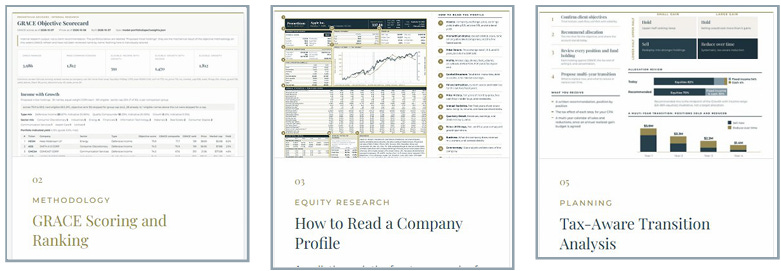
For the last three years, we have been expanding and refining our investment process to further complement our wealth and advisory services. To see our updated Firm Overview as well as our Global Research and Company Evaluation, Company Profiles, Tax Aware Transition Engine, and more, click here to go to our website.
Helping us with this, we are pleased to announce that Mary Kolesar has joined us as an investment analyst. Mary brings an applied mathematics background, youth, and a commitment to client service.
Two other things. We are adopting a new tech stack in the coming weeks which will give us advanced portfolio management tools fully integrated with secure AI. This has been a major project for the last year, and we are about to “go live.” The transition should be seamless to clients, and the advanced technology enables us to manage client portfolios more efficiently. It is just part of our ongoing commitment to adopting new tools designed to enhance our capabilities.
Secondly, we are moving offices a few blocks away as we have outgrown our space. Thus far, we have avoided the ego-gratifying large office buildout that doesn’t improve investment results or the client experience. I can’t promise that will never happen, just not yet.
RISING CASH FLOW, TAX-EFFICIENT COMPOUNDING
Over the last four years, the S&P 500 index is up 120%, compounding 21.9%.1313 Valuations are at historic levels, as are the use of debt and leverage trading in the market. The temporary inconvenience of “underperforming” for a year or so is one we are willing to endure in order to preserve capital if and when markets revert to the mean. We know from history, however, that just reverting to the mean rarely happens. Markets normally swing from very high valuations through “fair value” to very low.
“The four most dangerous words in investing are this time it’s different.”
Sir John Templeton
One of the wisest and best investors in the last 125 years, Sir John, was born dirt-poor and lived through the Great Depression. His observations about human behavior are timeless and call to question many of today’s beliefs. Those who believe 1) that emerging technology will solve inflation and overspending, 2) that every stock market dip is followed by a rally, and 3) that you can quit your job and trade yourself to fame and fortune remind the astute observer that not all that glitters is gold.14,15
Though we remain concerned about many economic developments and global conflicts, we are very encouraged about how they may affect us. We believe we are well positioned to participate in the evolving trends without being overly exposed to the leveraged segments of the markets.

Bob Dylan’s lyrics remind me of the tortoise and the hare illustration you may recall from our 4th Quarter 2023 Commentary, Tribute to Charlie Munger. Often, the laggards catch up when the leaders run out of gas.
“The slow one now, will later be fast As the present now, will later be past The order is rapidly fadin’, And the first one now will later be last, For the times they are a-changin’”
That’s why we own high-quality companies that provide essential products and services that attract loyal customers. Then we hold them and let them do the heavy lifting.
Christopher F. Poch
October 19, 2026
_________________________________________________________________________________________________________
- https://www.spglobal.com/spdji/en/research-insights/performance-reports/ ↩︎
- https://www.wsj.com/finance/stocks/u-s-stocks-fall-on-hot-inflation-report-ai-sell-off 6c98113d ↩︎
- https://en.macromicro.me/charts/123442/us-sp-500-top-10-companies-total-market-c ap-and-share ↩︎
- https://www.reuters.com/business/finance/investors-temper-anthropic-ipo-valuation expectations-over-revenue-growth-2026-10-15/ ↩︎
- https://www.ft.com/content/3beab58d-4269-4722-b299-8fa5a93f5a52?syn-25a6b1a6=1 ↩︎
- https://www.bls.gov/news.release/ppi.htm ↩︎
- https://www.bls.gov/news.release/cpi.htm ↩︎
- https://www.wsj.com/livecoverage/stock-market-today-dow-sp-500-nasdaq-09-30-20 26?st=tXxGFg&reflink=article_copyURL_share ↩︎
- https://www.wsj.com/economy/the-ai-build-out-is-becoming-the-biggest-economic bet-in-u-s-history-c60716dd ↩︎
- https://wccftech.com/foxconn-pegs-nvidia-vera-rubin-ai-datacenter-at-47-billion-per-gigawatt/ (Foxconn estimate: annual electricity cost of about $1.3 billion per gigawatt) ↩︎
- https://epoch.ai/publications/the-plunging-price-of-thought ↩︎
- https://startupfortune.com/jpmorgan-will-test-blockchain-settlement-for-japans-government-bonds/ ↩︎
- https://www.slickcharts.com/symbol/SPY/returns, October 14, 2022 – October 13, 2026 ↩︎
- https://www.wsj.com/finance/at-robinhoods-mecca-for-risk-loving-traders-everyone has-a-tale-of-getting-rich-f960d8c2 ↩︎
- https://www.wsj.com/articles/the-financial-lesson-of-2008-09-that-most-investors-ha ve-forgotten-11576630806 ↩︎
Disclosures
The views expressed are those of the author as of October 19, 2026, are based on information available as of that date, and are subject to change without notice. Certain statements are forward-looking, reflect current opinions and assumptions, and involve risks and uncertainties. Actual events and results may differ materially. References to specific securities, issuers, or investment themes are provided for illustrative purposes only and do not constitute a recommendation to buy, sell, or hold any security. The securities discussed may or may not be held in client portfolios, and no representation is made that any investment discussed was or will be profitable. Investment advisory services offered through Promethium Advisors, LLC, a Registered Investment Advisor with the U.S. Securities and Exchange Commission. This material is intended for informational purposes only. It should not be construed as legal or tax advice and is not intended to replace the advice of a qualified attorney or tax advisor. This information is not an offer or a solicitation to buy or sell securities. The information contained may have been compiled from third party sources and is believed to be reliable.

