

2nd Quarter 2026 Commentary & Outlook
Lady Gaga’s 2008 hit song “Poker Face” recounts a game where one party fools another and gets “bank.” This is common in the high-stakes business of developing new technology: not every participant ends up as a winner. In many cases, “fake it until you make it” is required until the new regime is adopted and cash flow turns positive. Some make it, others do not.
I wanna hold ’em like they do in Texas, please
Fold ’em, let ’em hit me, raise it, baby, stay with me (I love it)
Love Game intuition, play the cards with spades to start
And after he’s been hooked, I’ll play the one that’s on his heart.
The single’s release was just a week after Lehman Brothers declared bankruptcy, which triggered a cascading liquidity problem and the onset of the Great Financial Crisis (GFC).[1][2] The news of the song’s pending release started six months prior, which strangely coincided with the March 2008 collapse of Bear Stearns and the precursor to brewing problems. Neither of these items are related; yet in retrospect, like so many things that are hidden in plain sight prior to wide awareness, the signs of rising financial stress were all there.
One might wonder what is going through the mind of Sam Altman, OpenAI’s co-founder and CEO. It seems to us that signs of difficulties have been well known for months, yet the implications are only just now seeping into the narrative. We are taking our indicators from the actions of those AI participants who are among the most informed, notably Microsoft. We can’t know if these development will be a blip in a success story or an omen of deeper problems because we can’t read Altman’s poker face.
Looking back, looking forward
Before we get into what we believe is today’s game-theory version of Nash’s equilibrium,[3] we will recount why, in our experience, pursuing a lower risk strategy enables long-term compounding. We look for trends likely to occur over several years and seek investments that may compound while protecting the downside.
As the “short-term” crowd chases a new trend or abandons an old, share price movements can be down 50% or up 200% on any given security in a matter of weeks or months. These down drafts offer a chance to add to quality holdings. If our quality evaluations are right, and those companies’ earnings and value compounds for many years, real wealth can be created.
Portfolios
In our June 5th note, “Chips Too Blue?”, the increasing usage of AI has raised questions about whether some dominant franchises, once unchallengeable, were at risk of becoming a buggy whip or a Betamax (outdated and effectively useless). This will happen to most products eventually. However,
When the stock price of high quality, financially strong companies with profitable business, rising cash flow, and loyal customers “sell off,” no one rings a bell and says, “it’s time to buy.”
As the bulk of the money flows in and out of hot stocks, leveraged funds, and life-changing IPOs, we have seen the price of many less exciting companies sag. Our experience suggests that it is most likely people chasing “what is moving,” not what is valuable. We are not concerned that some of the prices of some of our high conviction companies are currently off. In fact, quite the opposite. When valuable franchises are selling at attractive prices, we are grateful and add to those positions.
For several years now, we have opined on the benefits of owning:
- Land, water and power
- Securities exchanges
- Blockchain
Let’s revisit recent developments.
Land Water Power
Three years ago, we posited that we didn’t know if the promises of AI were real, but if they were, data centers would be needed, and natural gas would be the preferred energy source. When the chip manufacturers’ revenues and stock prices exploded and the costs of hyperscalers who bought the chips exploded, and the stock prices of both groups surged, we opted to avoid the risk of either group imploding. We chose to participate in the land, water, and power, needed regardless of which companies ultimately “won.”
Among the first public announcements validating our thesis came less than a month ago, from the bluest of the “blue chip” companies,. The June 22, 2026, announcement by Chevron and Microsoft regarding the 2.67GW Project Kilby data center provides the details.[4]
“AI is reshaping the global economy, and abundant, affordable, reliable energy is essential to fueling that transformation. […] Chevron is uniquely positioned to deliver power to customers with certainty, speed and at a competitive cost, leveraging Permian natural gas and our proven execution capabilities.”
“The rapid growth we’re experiencing in AI and cloud, driven by customer demand, requires energy infrastructure that can scale quickly and reliably,” said Noelle Walsh, Microsoft president of Cloud Operations + Innovation. “Our agreement with Chevron helps ensure we’ll have dedicated, large-scale power to support the evolution and reliability of advanced compute.”
Three years ago, the limiting factors to the benefits of AI were GPU chips, then power, then data centers. More recently, it may be water.
“In lieu of freshwater, Kilby plans to use non-potable, brackish groundwater sources for power plant operations. Chevron is also working to advance solutions for reuse of produced water from oil and gas operations.”
What the Chevron release did not say was that the land on which this data center will be constructed is owned by Texas Pacific, TPL. From the June 23rd press release[5]:
“Texas Pacific Land Corporation Announces Agreement to Provide Land and Water Solutions to Chevron for a Large-Scale Power Project.”
Last year, some land, water, and power companies were not the shiny objects. Traders sold, and the prices suffered. Recently, they have become popular once again, and the traders have rushed in and pushed up prices 40-75%.[6] Short-term moves like these create opportunities to add to positions.
Securities exchanges
In 2025, a basket of four major US securities exchanges were up ~21%.[7] In the first half of this year, they were down over 18%.[8] The “SaaSpocalypse” is cited as the culprit. If you are not familiar with the term SaaSpocalypse, it is the combination of Software as a Service (SaaS) and apocalypse. This term describes what happened to many software companies stock prices. When people started to understand how AI would dramatically impact some businesses, much in the way the internet changed so many, the securities exchanges were included in that sell-off.
In our opinion, however, the business of these highly regulated entities remains intact. For example, the emergence of Kalshi, and other “predictions market” unregulated new entrants, is cited as a new threat. In our opinion, the ability of a retail-oriented fintech to beat the Chicago Merc would be akin to Robinhood replacing Goldman Sachs. As they say in a word: unlikely. AI will affect the business model of securities exchanges, but we suspect it will not derail where global institutions prefer to trade. We view these dips as opportunities to add.
Blockchain
Nothing has changed regarding the fundamental economic purpose of the bitcoin blockchain. The blockchain serves as a permanent, public record for transactions, every minute of every day, all over the world, and the cost of recordation is a fraction of traditional methods. That’s why banks like JP Morgan and others use it.
What has changed is the market’s opinion of the correlation to tech stocks and tolerance for risk, explaining much of the recent price movement. There is no better example of this than the travails of Michael Saylor and his highly leveraged company, Strategy [MSTR]. Issuing debt and preferred shares at a premium to the value of an underlying asset is a profitable strategy, as long as the price of the stock is higher than the value of the assets. If the share price trades below the underlying value and the payments out cannot be sustained by the revenue from the company, liquidity problems arise and can result in bankruptcy.
We have never favored this approach because, in our four decades as an investor, these structures, if not de-levered in time, eventually fail. We own bitcoin. We typically don’t own leveraged companies lacking operating revenues to pay the interest or preferred dividends owed. Too risky.
Back to the fundamentals, the amount of bitcoin awarded to validate each block of transactions continues to be cut in half every four years. The next “halving” is scheduled to occur around April 18th, 2028. We have studied the blockchain for nine years and have opined that the business of validating transactions on the blockchain is here to stay. The global institutional adoption has reinforced that belief.
The price of bitcoin has moved up and down with the general euphoria of the short-term group. The volatility has enabled us to add to these positions when the prospects of immediate gratification dim. Historically, the bitcoin price has loosely sloped higher as the “halving” of the “award” nears.
We can’t know if the price of bitcoin will go higher. However, if the economic value to validate a transaction doesn’t exceed the cost of the electricity and computers to validate them, the business fails. Historically, this has been the reason why the price of bitcoin has risen. We believe this should continue, and if it does, the price of bitcoin should reflect it.
Market & Economy
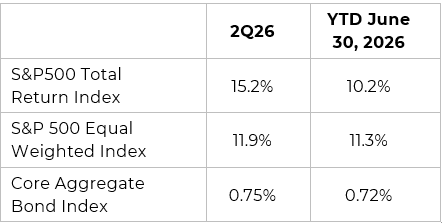
We have a new Chair of the Federal Reserve, the war in Iran drags on, and two interest rate cuts are priced into the market. Federal deficit spending continues unabated, SpaceX went public, and artificial intelligence is changing the world. We too believe there will be winners and losers; however, we are not sure who they will be.
Energy: Price of West Texas Intermediate (WTI) oil hit $102 at the end of March this year, peaked at $114 in early April, and by the end of June was below $70. [9] So, one might ask, why are the land, water, and power companies we favor doing well this year? The consensus is that regardless of who the winners are in AI (microchip manufacturers, memory chip makers, or hyperscalers), AI is here to stay, and data centers are critical.
Water: Several times in the few last years, we have commented on how much water is required to operate data centers, primarily for the power to generate electricity and to some extent to cool them. Recently, articles started to appear indicating the amount water required was “much less” due to closed-loop cooling systems.[10] As is often the case, the company press releases told most of the story, but not all.[11]
Credit: Private credit continues to suffer. Estimates from MSCI suggest the price of software loans in private credit funds that have been marked down more than 20% has hit a five-year high.[12] PricewaterhouseCoopers estimates that there is a nine-year backlog of companies to sell at prices, apparently, no one is willing to pay.[13] [14] As a result, or possibly because of this, investor redemption requests are higher than 1Q26, and are being capped.
Private equity sponsors have established lines of credit to satisfy withdrawal requests, but with the current lack of liquidity, it could be another two years before all requests are satisfied.[15] Historically during periods of mass redemptions, fund managers would sell the most liquid loans at the prices closest to cost. This left the remaining investors stuck in the funds owning the more questionable bonds and additional debt to be repaid.
Free Cash Flow: The top five “hyperscaler” tech companies, which generated hundreds of billions of free cash flow a few years ago, are on pace to generate close to zero free cash flow this year. Estimates suggest that their collective free cash flow will be negative next year supported by the fact that they have been selling debt and equity to pay for their massive build out.[16] If the hyperscalers’ business model goes from a low capital-intensive business to a high capital-intensive business, profits drop and the price to earnings ratio could collapse.
Meta does a 180
Over the last two years, hyperscalers have invested massive amounts of money into AI to maximize their compute capacity and stay competitive. The narrative was that you had to have “more,” and share prices rose each time a company announced higher CapEx commitments. Recently, however, Meta announced they are setting up a business to sell their excess compute capacity.[17] The stock rallied on the news, but we find this curious. Some might observe that this move could be evidence that the companies don’t need as much “computing” capacity, their massive CapEx build out is overblown:, and they may be seeking ways to off-load their miscalculations.
If that is true, what happens to the GPU/CPU and memory chip manufacturer’s future revenue and profits? Can they stay at 75-80% profit margins? What happens to OpenAI? Last year, OpenAI committed to spending $1.4 trillion and had to cut it back to a “modest” $600 billion.[18] The Wall Street Journal reported that OpenAI cut prices and offered, without being asked, 5% of the company to the US government.[19] Their estimated loss for the current year was projected to be $13 billion and has more than doubled to $28 billion.[20] This doesn’t sound like a company, or industry for that matter, operating from a position of strength. We don’t know where this leads, but we do not want to get caught “holding the bag” if the music stops.
Betting the Over/Under
We see reasons why the narrative may shift away from favoring the dozen or so companies that have benefited from the AI trend. Chuck Prince, the CEO of Citigroup, infamously said in July of 2007 that you had to dance while the music was playing. About nine months later, the music started to slow when Bear Stearns went under, and six months after that, the music stopped.[21]
The rate of increase in the valuation of OpenAI is slowing while the company burns cash at an alarming rate. If they cannot continue to raise additional funds, the music stops. Sam Altman may have a poker face when extolling the virtues of an AI driven utopian future to the media, private equity partners and investment bankers who are anxious to take OpenAI public (and earn fees that could approach $1 billion). Few know the exact financials or the terms of OpenAI’s ~$500 billion in future commitments that they don’t have. If OpenAI succeeds at scale, Altman holds more than $2 billion in companies that do business with OpenAI and would benefit. It matters less if one can’t read another’s poker face as long as you can read their balance sheet and income statements. From what we can see, we will bet the “under” on OpenAI.
Our inclination is to look at what we believe will happen in two to three years and to own companies that should benefit if we are right. Many of the things we have anticipated are coming to fruition. As the crowd chases shiny objects, and assets flow in and out of industries, we are steadily accumulating a few wonderful franchises at attractive valuations.
Conclusion
We recently celebrated the 250th anniversary of the adoption of the Declaration of Independence. It is worth pausing for a moment to be grateful for where we live and the liberties we enjoy. The United States is blessed with abundant natural resources, two large oceans on either side, and two friendly neighbors north and south of us. Despite the immediate problems facing us, opportunities abound, and we are optimistic about the future. May God bless America.
Thank you for your confidence. We appreciate your trust.
Christopher F. Poch
July 15th, 2026
[1] https://www.wsj.com/articles/SB122145492097035549
[2] https://en.wikipedia.org/wiki/Poker_Face_(song)
[3] https://en.wikipedia.org/wiki/Nash_equilibrium
[4] https://www.chevron.com/newsroom/2026/q2/chevron-signs-20-year-power-agreement-with-microsoft-for-west-texas-data-center
[5] https://www.texaspacific.com/investors/news-events/press-releases/detail/185/texas-pacific-land-corporation-announces-agreement-to
[6] Prices as of July 13, 2026.
[7] https://totalrealreturns.com/s/ICE,NDAQ,CME,CBOE?start=2024-12-31&end=2025-12-31
[8] https://totalrealreturns.com/s/ICE,NDAQ,CME,CBOE?start=2025-12-31&end=2026-06-30
[9] https://www.macrotrends.net/2516/wti-crude-oil-prices-10-year-daily-chart
[10] Nvidia wants to cut data center water use, but that’s not the same as fixing AI’s water problem, Jun 22, 2026
[11] AI Data Centers Use Far More Water Than Most Tech Giants Report. July 3 2026
[12] Software Loans Hit Rough Patch Even Before AI Fears Triggered SaaS-Pocalypse
[13] Investors Seek to Pull Nearly $16 Billion From Private-Credit Funds, July 2. 2026 WSJ
[14] Private-Equity Firms Are Sitting on a Nine-Year Backlog, Wall Street Journal July 7, 2026
[15] Private Credit Keeps $14.5 Billion Locked Up, July 3, 2026
[16] Bank America Research, Bloomberg.
[17] Meta Is Planning a Cloud Business to Sell AI Computing Power, July 1, 2026
[18] https://www.cnbc.com/2026/02/20/openai-resets-spend-expectations-targets-around-600-billion-by-2030.html
[19] https://www.wsj.com/tech/ai/openai-considers-drastic-price-cuts-anticipating-war-for-users-with-anthropic-9b8c178e
[20] https://www.bloomberg.com/news/articles/2026-07-01/meta-is-building-a-cloud-business-to-sell-excess-ai-compute
[21] https://archive.nytimes.com/dealbook.nytimes.com/2010/04/08/prince-finally-explains-his-dancing-comment/
Important Disclosures
Investment advisory services offered through Promethium Advisors, LLC, a Registered Investment Advisor with the U.S. Securities and Exchange Commission. This material is intended for informational purposes only. It should not be construed as legal or tax advice and is not intended to replace the advice of a qualified attorney or tax advisor. This information is not an offer or a solicitation to buy or sell securities. The information contained may have been compiled from third party sources and is believed to be reliable.

